Short answer
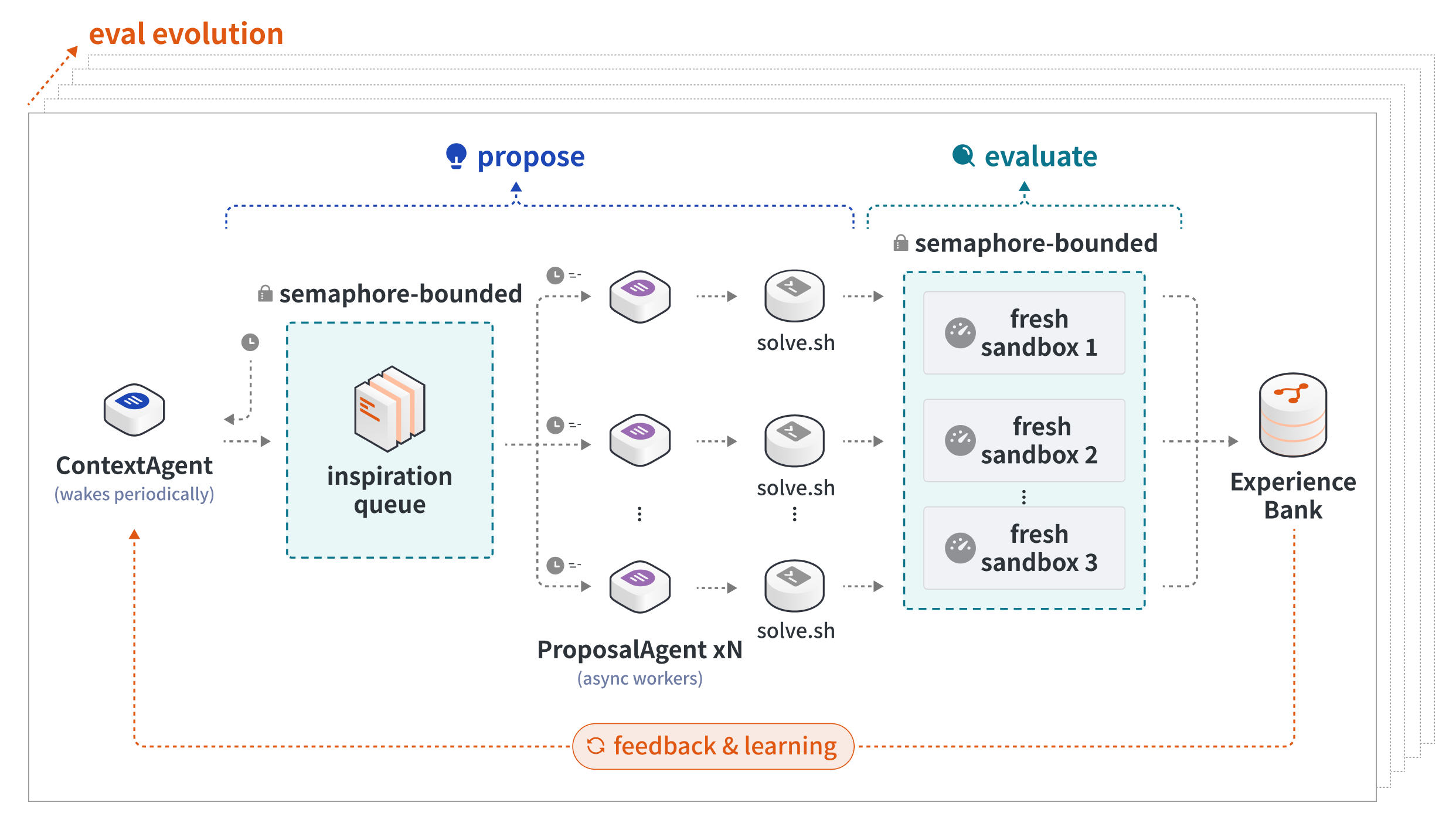
Hyra, short for Hunyuan Research Agent, is an autonomous research system that repeatedly proposes solutions, runs them in isolated sandboxes, scores the results, and stores code, logs, artifacts, and evaluator feedback in an Experience Bank. Multiple agents explore in parallel, while an outer loop can improve the evaluator itself when the original metric is weak or incomplete.
Key takeaways
Core loop: Propose a solution, execute it in a fresh sandbox, evaluate it, and feed the full result back into the next search round.
Shared memory: The Experience Bank retains source code, artifacts, logs, scores, and evaluator feedback—not just a short text summary.
Evaluator evolution: For open-ended tasks, Hyra can improve the scoring system as well as the solution, reducing blind spots and reward hacking.
Public evidence: The official repository contains result artifacts and reproducible scripts across AI4AI, AI4Science, and AI4Fun under Apache 2.0.
Hyra research loop at a glance
| Topic | Input | Core work | Output |
|---|---|---|---|
| 01 · Context | Task definition plus the accumulated Experience Bank. | Select diverse code, artifacts, logs, scores, and feedback to create inspiration contexts. | A queue of distinct research directions for parallel exploration. |
| 02 · Propose | One inspiration context from the task queue. | Reflect on prior attempts and write a new executable solution with a solve.sh entry point. | A complete candidate solution ready for isolated execution. |
| 03 · Evaluate | The candidate solution and task-specific evaluator. | Run in a fresh sandbox, verify behavior, calculate metrics, and capture logs and artifacts. | A scored attempt returned to the Experience Bank. |
| 04 · Evolve | The strongest solutions and evidence of evaluator weaknesses. | Improve evaluation speed, granularity, robustness, and resistance to metric exploitation. | A stronger search environment for the next research cycle. |
What Hyra Is
Hyra-1.0 is Tencent's Hunyuan Research Agent: a general framework for performance-driven research and engineering. Instead of answering once, it turns a task into a continuing search process in which solutions are written, executed, measured, compared, and improved.
The same harness is designed to work wherever progress can be tested: model training, systems optimization, mathematical construction, scientific data analysis, molecular design, games, music, and programmatic 3D creation.
How the Experience Bank Drives Recursive Improvement
A Context Agent maintains the Experience Bank and assembles diverse inspiration packages from earlier source code, files, run logs, artifacts, scores, and evaluator comments. Those packages enter a task queue instead of being compressed into a single generic memory.
Multiple Proposal Agents consume different contexts in parallel and write new solution folders with solve.sh as the entry point. Each candidate runs in a clean sandbox, receives a score, and returns to the Experience Bank, creating an asynchronous producer-consumer pipeline that can keep compute, sandboxes, and model calls busy.
Why Hyra Improves the Evaluator Too
Strong search quickly discovers weaknesses in a metric. The official article describes candidates that lowered language-model loss by leaking future tokens and GPU kernels that cached answers during correctness checks before doing no work during timing. Both scored well without solving the intended problem.
When a task lacks a reliable evaluator, Hyra uses a nested loop: the inner loop improves solutions, then the outer loop revises the evaluator for speed, precision, resistance to reward hacking, and room for further progress. The upgraded evaluator starts the next search cycle.
Results Across AI Engineering and Scientific Discovery
In the launch results, Hyra improved three established AI research tasks: NanoChat validation BPB reached 0.9015, NanoGPT reached 3.28 validation loss in 76.4 seconds, and SOL-ExecBench mean SOL reached 0.771 across the published setup.
The official results repository also publishes advances in mathematical optimization, packing, quantum routing, symbolic forecasting, drug docking, and compact neural architectures. A 15-parameter Transformer performed 10-digit addition at the target accuracy, while the reported sunspot formula achieved approximately 0.78 forecast R² on a long held-out interval.

Four New Mathematical Advances Published in August
Tencent's August 19 update added four notable results: the 3D Blaschke–Lebesgue universal lower bound rose from about 0.380799w³ to above 0.411040w³; the Beurling–Ahlfors uniform coefficient fell from 1.575 to 1.523958; the known power-law threshold for partial Hadamard matrix counting moved from exponent 3 to 2; and the commutator construction improved from O(log⁴(1/ε)) to O(log³(1/ε)).
The repository includes manuscripts and, for three of the newest results, Lean 4 formalizations of their finite or numerical cores. That makes the public release more useful than a leaderboard claim alone: readers can inspect the argument, artifacts, and verification code.
What Hyra's 3D Experiments Show
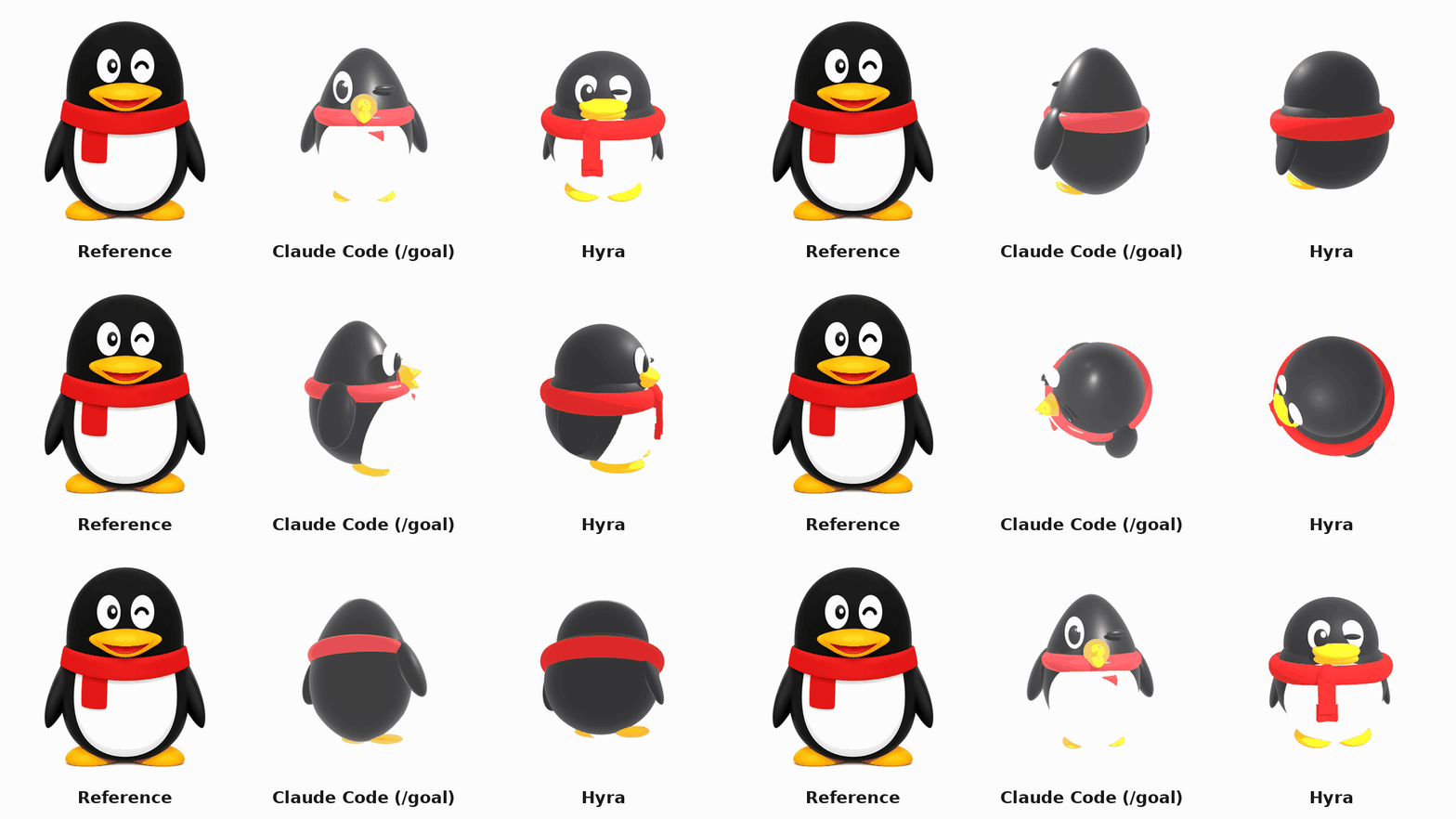
For 3D creation, Hyra receives a single 2D reference, writes Blender Python, renders the result, and uses a rubric-based vision-language judge to score silhouette, proportion, structural completeness, materials, and visual similarity. The loop keeps editing modeling code and render parameters until the asset improves.
The open artifacts include a procedural QQ penguin and a Hunyuan logo orb. This is code-driven Blender modeling rather than a general image-to-mesh service, but it demonstrates how a research agent can turn visual feedback into repeated, measurable improvements to a 3D asset.
Frequently Asked Questions
Hyra stands for Hunyuan Research Agent. Hyra-1.0 is Tencent's autonomous research framework for performance-driven scientific and engineering tasks.
Hyra is an agent framework. It coordinates context selection, parallel proposal agents, sandboxed execution, evaluators, and an Experience Bank; the underlying models are components of that larger loop.
Each run returns source code, artifacts, logs, scores, and feedback to the Experience Bank. New agents receive selected parts of that history and propose better candidates. For open-ended tasks, an outer loop can also redesign the evaluator.
The official Hyra-results repository is public under Apache 2.0 and contains solution artifacts plus reproducible scripts where relevant. As of August 25, 2026, it is a companion results repository rather than a packaged one-command release of the full Hyra harness.
Yes. The official demos show Hyra writing and refining Blender Python to reproduce a 3D object from a single 2D reference. This experiment uses iterative code generation and visual evaluation rather than a standard image-to-mesh model.
Published artifacts cover model training, training speed, GPU kernels, mathematical inequalities, geometric packing, compact neural networks, molecular docking, quantum routing, symbolic forecasting, games, music, and procedural 3D design.
Turn an image into a production-ready 3D starting point
Generate a textured character, prop, product, or scene asset from a reference image in your browser.
Try Image to 3D